

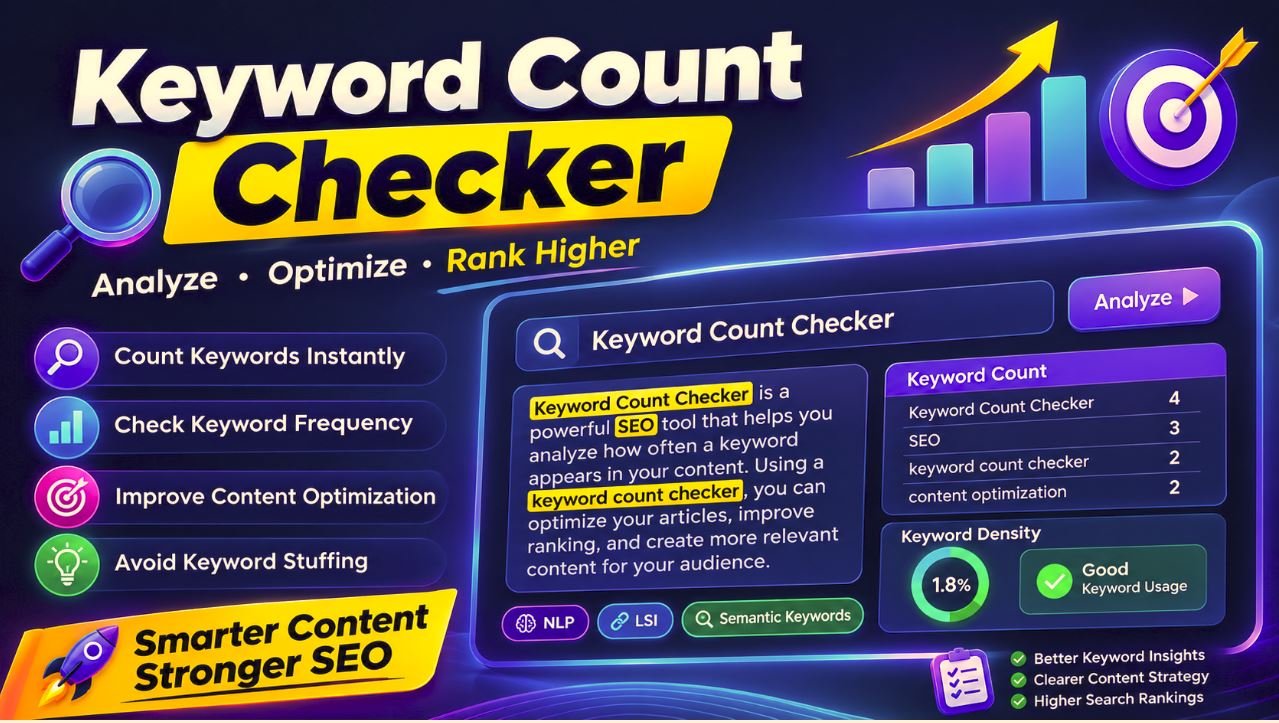
What Is a Keyword Count Checker?
A keyword count checker analyzes written content and reports how frequently selected words or phrases appear. Depending on the tool, it may also display total word count, keyword density, repeated phrases, and other basic content metrics. This makes it useful for SEO audits, blog optimization, copywriting, and content editing.
For beginners, the process is straightforward: enter or paste your content, specify a target keyword, and review its frequency. A good workflow does not aim for a fixed percentage. Instead, it uses keyword data to identify overuse, underuse, missing variations, and opportunities to improve topical completeness while keeping the writing natural.
- 🔍 Check exact keyword frequency
- 📊 Measure keyword density
- 📝 Review content before publishing
- 🎯 Identify optimization opportunities
- 🧠 Understand topical relevance
- ✨ Improve natural keyword placement
- 🚀 Support on-page SEO
- ✅ Make editing more systematic
Why Is Keyword Counting Important for SEO?
Keyword counting can help you understand whether your content sufficiently addresses the topic suggested by the primary search query. If a target phrase never appears, search engines and readers may have less explicit evidence about the page’s subject. Conversely, excessive repetition can make copy sound unnatural and potentially create a poor user experience.
The real objective is relevance rather than repetition. Search engines increasingly understand synonyms, entities, related concepts, and conversational language through natural language processing. A keyword count checker therefore becomes most valuable when it supports editorial judgment rather than replacing it. Think of it as a diagnostic tool, not a formula for ranking.
- 🎯 Confirm primary-topic coverage
- 🔎 Find missing keyword variations
- 📈 Support on-page optimization
- 🧩 Improve semantic relevance
- 🧠 Encourage NLP-friendly writing
- ✍️ Reduce unnecessary repetition
- 👀 Improve reader experience
- 🌐 Strengthen topical depth
How Does a Keyword Count Checker Work?
Most keyword counting tools process the text and identify repeated words or phrases. An exact-match checker counts occurrences of the specified phrase, while more advanced tools can identify variations, related terms, and sometimes grammatical forms. Some platforms also calculate keyword density by dividing keyword occurrences by total words.
For example, if a 1,000-word article contains a target phrase 10 times, its basic keyword density is 1%. However, that number alone does not determine whether the content is optimized. A comprehensive analysis should consider placement, search intent, readability, synonyms, semantic keywords, headings, and whether the article genuinely answers the user’s question.
- ⚙️ Paste your written content
- 🔤 Enter the target keyword
- 🔢 Count exact occurrences
- 📐 Calculate keyword density
- 🔗 Compare related phrases
- 🧠 Examine semantic variations
- 📚 Review topical coverage
- ✅ Edit where necessary
Keyword Density vs. Keyword Frequency: What’s the Difference?
Keyword frequency simply refers to how many times a word or phrase occurs in a document. Keyword density expresses that frequency as a percentage of the total word count. These measurements are related but not identical. Frequency tells you the raw number; density gives you a normalized figure that can help compare articles of different lengths.
Neither metric should become an artificial ranking target. Modern SEO emphasizes satisfying search intent, providing useful information, demonstrating topical expertise, and using language naturally. If your article requires a phrase several times to explain the subject clearly, use it. If repeating it makes the text awkward, use synonyms and relevant semantic terminology instead.
- 🔢 Frequency shows total uses
- 📐 Density shows percentage
- 📄 Long content changes density
- ✍️ Natural writing remains essential
- 🧠 Context matters more than repetition
- 🔄 Synonyms prevent monotony
- 🎯 Search intent guides optimization
- 🚫 Avoid mechanical keyword stuffing
How Many Times Should You Use a Keyword?
There is no universal keyword frequency that guarantees higher rankings. The ideal number depends on the topic, content length, search intent, terminology, and natural requirements of the subject. Instead of forcing a predetermined percentage, mention the primary keyword where it makes sense, particularly in important contextual locations such as the title, introduction, relevant headings, and body copy.
Use LSI-style related terms, entities, synonyms, and semantic keywords to broaden topical coverage. For example, an article about keyword analysis might naturally discuss keyword frequency, keyword density, SEO content, search queries, related phrases, topical relevance, on-page SEO, and content optimization. This approach creates richer and more useful content.
- 🎯 Prioritize relevance
- 🧠 Use semantic relationships
- 🔄 Include natural variations
- 📝 Optimize important sections
- 👓 Write for humans first
- 📚 Expand topical coverage
- 🚫 Never force repetitions
- ✨ Keep language conversational
Keyword Count Checker and NLP: What You Should Know
Natural Language Processing (NLP) allows search technologies to interpret language beyond simple keyword matching. NLP systems can analyze relationships between words, entities, phrases, intent, and context. For content creators, this means an article can demonstrate strong topical relevance without repeatedly using the exact same keyword.
An NLP-focused content strategy should include entities, related concepts, natural synonyms, question-based phrases, and terminology that commonly appears around the main subject. A keyword count checker can help verify important phrases, while semantic analysis helps ensure the article covers the broader topic. Even a term such as zuhio should only appear when it fits naturally rather than being inserted mechanically.
- 🧠 Understand natural language
- 🔗 Connect related concepts
- 🏷️ Include relevant entities
- 💬 Use conversational phrases
- ❓ Answer related questions
- 🔄 Add meaningful synonyms
- 📖 Build contextual depth
- 🚀 Support semantic SEO
LSI Keywords and Semantic Keywords for Better Content
The term LSI keywords is commonly used in SEO to describe words and phrases related to a primary topic. Strictly speaking, modern search engines do not simply depend on traditional latent semantic indexing to rank web pages. Nevertheless, incorporating closely related terminology can improve topical completeness and make content more understandable.
For a keyword count checker article, related terms might include keyword analyzer, keyword frequency tool, keyword density checker, SEO content checker, search engine optimization, content relevance, target keyword, related keywords, topical authority, and on-page SEO. These terms should appear because they contribute meaning, not because an arbitrary keyword list says they must be included.
- 🧩 Add closely related terminology
- 🔍 Use keyword variations
- 🧠 Expand topical context
- 📚 Cover subtopics thoroughly
- 🎯 Match search intent
- 🔗 Connect concepts naturally
- ✍️ Avoid repetitive wording
- 🌟 Improve semantic richness
Best Practices for Using a Keyword Count Checker
Start by identifying one primary search term and several supporting concepts. Then create useful content around the reader’s intent before checking keyword frequency. Once your draft is complete, run it through a keyword counter and inspect unusually high or low frequencies. Look especially at repeated phrases that do not contribute additional meaning.
Next, improve readability and topical coverage. Place important terms naturally in headings, introductory copy, descriptive subheadings, and relevant paragraphs. Remove unnecessary repetitions and replace some repeated phrases with accurate synonyms or contextual terms. This balanced approach can make your content easier for readers, search engines, and AI-powered search systems to interpret.
- 📝 Define the primary keyword
- 🎯 Identify search intent
- ✍️ Write naturally first
- 🔢 Check frequency afterward
- 🔍 Review repeated phrases
- 🧠 Add semantic variations
- 🚫 Remove awkward repetition
- 🚀 Publish only after editing
Final Thoughts: Use Keyword Counting as an SEO Aid
A word count checker is valuable because it turns an otherwise subjective part of content optimization into something measurable. It can reveal repetition, confirm whether important terminology is present, and help writers make informed editorial decisions. However, counting keywords should never become more important than usefulness, originality, readability, and search intent.
The strongest SEO content combines keyword analysis with semantic optimization, NLP-aware writing, helpful information, logical structure, and excellent user experience. Use keyword frequency as one signal among many. When your content naturally covers the subject in depth and answers the audience’s questions, tools such as keyword counters can support—not replace—good SEO strategy. A thoughtfully optimized page should inform first and optimize second.
- 🏆 Focus on helpful content
- 🔎 Monitor keyword frequency
- 🧠 Think semantically
- 🎯 Satisfy search intent
- ✨ Protect readability
- 📚 Build topical authority
- 🤖 Optimize for AI search
- 🚀 Keep improving content