

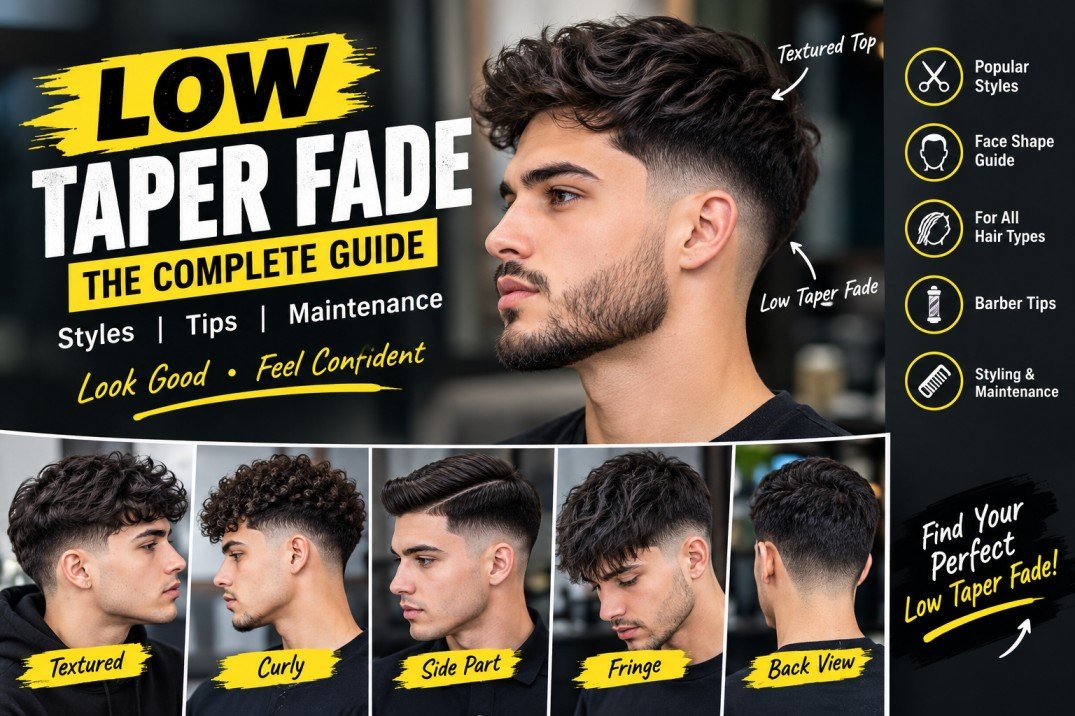
The low taper fade has become one of the most versatile men’s haircuts for barbers. It creates a clean transition around the temples, sideburns, and neckline while leaving more length and weight on the sides and top. Its subtle appearance makes it suitable for clients who want a polished haircut without an aggressive skin fade.
For professional barbers, the low taper fade is more than simply reducing hair length. It requires controlled clipper work, smooth blending, attention to natural growth patterns, and an understanding of the client’s hair texture and desired silhouette. When performed correctly, the haircut looks balanced, clean, and natural from every angle.
What Is a Low Taper Fade?
A low taper fade gradually reduces the hair around the lowest portions of the haircut, particularly the sideburns, temples, ears, and neckline. Unlike a high fade, the taper remains close to the natural edges of the head. This preserves substantial weight through the sides while creating a noticeably cleaner perimeter.
The low taper is especially useful for clients who want a modern haircut without committing to a dramatic fade. Barbers can customize the lowest point using different clipper guards, trimmers, or a razor finish. The final result may range from a soft natural taper to a sharper, skin-close finish.
- Low fade placement
- Clean sideburns
- Tapered neckline
- Natural temple area
- Controlled clipper work
- Gradual blending
- Retained side weight
- Customizable finish
Low Taper Fade vs. Low Fade
Although low taper fade and low fade are sometimes used interchangeably by clients, they can describe different haircut structures. A low taper normally concentrates the fade around the edges, while a low fade generally extends the graduated transition farther across the lower sides and back of the head.
Understanding this difference helps barbers manage client expectations. If a client wants the sides to remain relatively full, a low taper is often the appropriate approach. If they want more visible fading across the lower side panels, a traditional low fade may be more suitable.
- Taper stays closer to edges
- Low fade covers more area
- Taper retains more weight
- Fade creates stronger contrast
- Both require blending
- Guard selection varies
- Client consultation matters
- Reference photos help
How to Cut a Low Taper Fade
Begin by identifying the client’s natural sideburns, temple area, neckline, and growth patterns. Establishing the taper too high can remove unnecessary weight and change the haircut’s overall shape. A conservative initial guideline allows the barber to build the blend gradually rather than trying to correct an overly high taper later.
Use appropriate clipper guards to progressively soften the transition between lengths. Depending on the desired finish, the barber may combine lever-open and lever-closed positions, clipper-over-comb, trimmers, and detail work. Work carefully around curves because the temple and neckline require different hand positioning and clipper control.
- Analyze hair growth
- Establish low guidelines
- Start conservatively
- Use clipper guards
- Adjust the lever
- Blend progressively
- Detail difficult areas
- Check both sides
Low Taper Fade Clipper Techniques
Effective clipper technique is essential for producing a seamless taper. Barbers should avoid digging the clipper into the hair because excessive pressure can create dark spots or unwanted holes. Light flicking motions help remove weight gradually and maintain control around the temple and neckline.
The corners of the clipper blade can provide additional precision in tight areas. A barber can use small, controlled movements to erase remaining lines without disturbing surrounding hair. Combining guards with lever adjustments creates multiple cutting lengths, allowing the transition to become progressively softer.
- Use light pressure
- Master flick-out motion
- Control the clipper lever
- Use blade corners
- Avoid deep clipper strokes
- Blend in small sections
- Check dark spots
- Detail remaining lines
Low Taper Fade for Different Hair Types
Hair texture significantly affects how a low taper fade should be performed. Straight hair can reveal blending imperfections easily, while wavy hair naturally disguises some transitions. Curly and coily hair require careful consideration of curl formation, density, shrinkage, and the client’s natural hair pattern.
For thick or dense hair, controlled debulking may be necessary before finishing the taper. Fine hair requires a lighter approach because aggressive clipper work can make the sides appear excessively thin. A skilled barber adjusts technique according to density rather than applying exactly the same method to every client.
- Straight hair
- Wavy hair
- Curly hair
- Coily hair
- Thick hair
- Fine hair
- Dense hair
- Textured hair
Best Hairstyles With a Low Taper Fade
One advantage of the low taper fade is its compatibility with numerous hairstyles. Barbers can pair it with a textured crop, fringe, quiff, comb over, slick back, messy hairstyle, buzz cut, curls, or longer top. The taper provides a clean perimeter while allowing the client to express their preferred style through the top.
The ideal combination depends on hair length, density, face shape, and styling habits. A barber should consider how the finished haircut will behave after the client leaves the shop. Good consultation involves discussing maintenance, styling products, and the amount of time the client is willing to spend on their hair.
- Textured crop
- French crop
- Modern quiff
- Comb over
- Slick back
- Curly top
- Messy hairstyle
- Buzz cut
Low Taper Fade and Face Shape
A professional barber should consider face shape when customizing the low taper fade, although the haircut can work across many facial structures. The key is balancing the top, sides, and taper rather than following a rigid formula. Oval, square, round, rectangular, heart, and diamond-shaped faces can all accommodate customized versions.
For rounder faces, controlled height on top can create a more elongated visual profile. Longer face shapes may benefit from avoiding excessive vertical height. Square faces can support structured styling, while softer textures may complement sharper facial features. These adjustments should remain subtle and based on the client’s natural proportions.
- Oval face
- Round face
- Square face
- Rectangle face
- Diamond face
- Heart face
- Adjust top height
- Balance side volume
Low Taper Fade Maintenance and Barber Tips
A low taper fade grows out relatively naturally because the shortest sections are concentrated around the perimeter. However, clients who prefer crisp edges may require regular barber appointments. The maintenance interval depends on hair growth rate, desired sharpness, shortest taper length, and how quickly the neckline or sideburns become noticeable.
Barbers should explain aftercare before completing the service. Clients can maintain the appearance with suitable shampoo, conditioner, styling products, and regular edge cleanup. Avoiding excessive product buildup also helps the haircut retain its texture and shape. A simple maintenance routine can significantly extend the polished appearance.
- Schedule regular touch-ups
- Keep neckline clean
- Maintain sideburns
- Avoid excessive product
- Choose suitable shampoo
- Condition when needed
- Brush or style appropriately
- Communicate maintenance needs
How Barbers Should Consult Clients
A successful low taper fade starts before the clippers touch the hair. Ask the client how low they want the taper, whether they want a natural or sharp finish, how much length they want retained on the sides, and what hairstyle they prefer on top. A consultation reduces misunderstandings and improves client satisfaction.
Barbers should also examine previous haircut patterns, cowlicks, uneven growth, hairline shape, density, and styling direction. Encourage clients to show a reference photograph, but explain that hair texture and head shape can affect the final result. The goal is to adapt the requested haircut to the client’s individual characteristics.
- Ask about taper height
- Discuss desired length
- Check hair density
- Examine growth patterns
- Review the neckline
- Discuss styling habits
- Request a reference photo
- Confirm the final shape
Final Thoughts
The low taper fade is a valuable haircut for both clients and professional barbers because it combines versatility, clean detailing, and adaptable styling. Its low placement preserves more of the natural side shape while providing a refined finish around the temples, ears, sideburns, and neckline. For barbers, mastering this haircut requires more than knowing clipper guard numbers. Strong consultation, precise guideline placement, controlled lever work, flick-out technique, texture awareness, and detailed finishing all contribute to a professional result. With practice, the low taper fade can become a dependable service for a wide range of men’s hairstyles.